Ask a family with significant wealth who coordinates their CPA, estate attorney, and investment advisor, and the honest answer is often "no one." Each professional does good work. The trouble sits in the space between them, and that gap, more than investment returns, is usually what sends a family looking for outside leadership.
A family office is the structure a family uses to manage its finances, planning, and administration across generations. Some families staff one in-house. Many choose outsourced family office executive services instead, placing day-to-day leadership and coordination with an outside team while the family keeps final decision rights.
For parents and grandparents already funding private school tuition and education trusts for several children, the question tends to arrive sooner than they expect.
TL;DR Quick Answers
Outsourced Family Office Executive Services
Outsourced family office executive services give a family one coordinating partner who leads the day-to-day work of its family office, while the family keeps final decision rights and its trusted CPA, attorney, and other advisors.
What it is: senior leadership and a single point of accountability for a family's financial life, provided by an outside team instead of in-house staff.
What it covers: Personal CFO oversight, advisor coordination, consolidated reporting, tax-time readiness, estate and wealth transfer coordination, and family governance support.
What it is not: a replacement for your advisors. Your attorney and CPA still provide legal and tax advice, and the provider aligns everyone around shared information and drives follow-through.
Who it fits: business owners, families with multiple entities, trusts, or properties, and families facing a liquidity event or generational transition.
When to act: before a major transition, so the family designs the structure on its own terms.
Top Takeaways
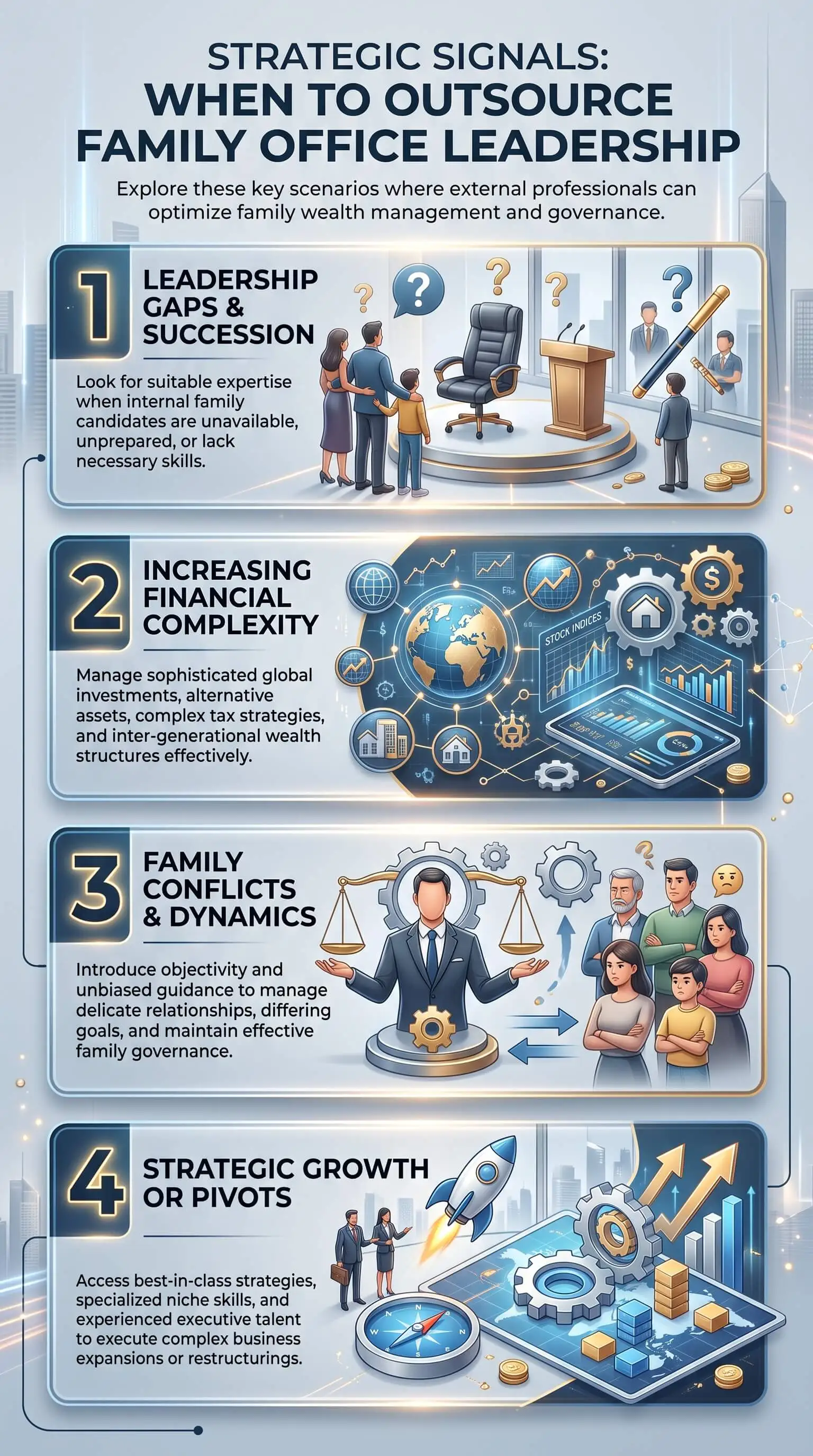
Families usually outsource family office leadership when coordination becomes the bottleneck, even if their investments are doing fine.
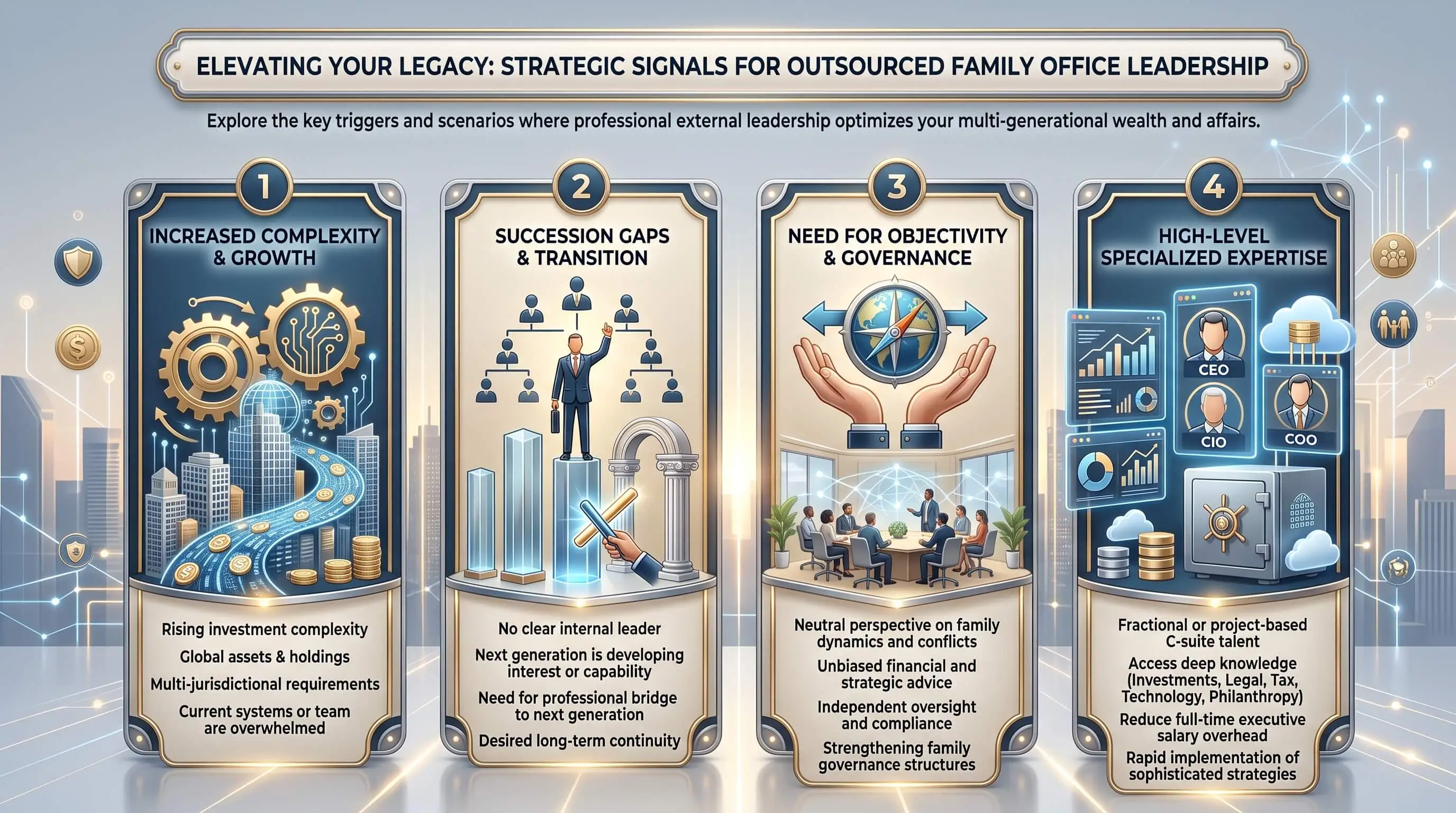
Common triggers include a liquidity event, a key person leaving, the next generation stepping in, and reporting scattered across entities.
Outsourced family office executive services cover coordination, Personal CFO oversight, reporting, and planning support, and existing advisors stay in place.
The family should always keep final decision rights, its values, and full access to records.
Before engaging any provider, check its fiduciary status, fee transparency, reporting quality, and security.
What Does Family Office Leadership Actually Cover?
Family office leadership is the set of roles that keeps a family's financial life organized, coordinated, and moving forward. A large single-family office hires for each role separately. In most families, one or two people carry all of it, and one of them is often the person who built the wealth.
Chief executive or coordinator: sets priorities, runs meetings, and keeps every advisor working from the same plan.
CFO or controller: oversees cash flow, the balance sheet, bill pay, and consolidated reporting across accounts and entities.
Investment oversight: monitors managers and allocation against the family's goals.
Governance and administration: organizes documents, tracks decisions, and prepares the next generation to take part.
When nobody fills these roles, the work still gets done. It just gets done late, or twice, or at the kitchen table on a Sunday night.
Seven Signs It Is Time to Outsource Family Office Leadership
A single event rarely prompts the move. More often, several pressures build until the current setup can no longer keep pace.
Your advisors work in silos. The CPA hears about a trust change after the fact, and no one tracks the action items from the last meeting.
A family member is serving as the unpaid chief executive. The founder spends evenings chasing statements and signatures instead of running the business or enjoying retirement.
A liquidity event is on the horizon. A business sale or large inheritance compresses years of tax, estate, and investment decisions into a few months.
A key person is leaving. When a longtime bookkeeper, executive assistant, or trusted controller retires, their knowledge leaves with them.
The next generation is stepping in. Adult children are joining decisions, and the family needs structure, education, and clear roles.
Reporting is scattered. Operating businesses, farmland, rental properties, and trusts each produce their own statements, and nobody sees one consolidated view.
An in-house team would cost more than the complexity justifies. The family needs senior oversight without the payroll, benefits, and office space of a full staff.
If three or more of these sound familiar, your family is probably already paying for the gap in lost hours, missed deadlines, or taxes that better coordination could have avoided.
In-House, Outsourced Executive, or Multi-Family Office?
Families generally fill these leadership roles in one of three ways, and each model trades control against cost and depth.
In-house single-family office
Cost structure: full salaries, benefits, and overhead
Control: highest, with staff reporting directly to the family
Depth of expertise: limited to the people you hire
Continuity: at risk when key staff leave
Best fit: very large, highly complex estates
Outsourced executive services
Cost structure: a fee for a defined scope
Control: the family keeps decision rights while the provider runs execution
Depth of expertise: senior specialists on demand
Continuity: the provider carries institutional knowledge
Best fit: families that need senior oversight without a full staff
Multi-family office
Cost structure: a shared platform, usually more efficient
Control: the family keeps decision rights within standardized processes
Depth of expertise: a broad team across disciplines
Continuity: team-based, with less reliance on any one person
Best fit: families that want coordination plus planning and reporting
Many families blend the models, keeping one trusted internal person while outsourcing the executive and CFO functions.
What Do Outsourced Family Office Executive Services Typically Include?
Outsourced family office executive services cover the leadership and coordination work that ties a family's advisors together. Scope varies by provider, though it commonly includes:
Personal CFO oversight of cash flow, the balance sheet, and recurring obligations
Coordination of the CPA, estate attorney, insurance, and investment professionals
Consolidated reporting across accounts, entities, and trusts
Tax-time readiness and document gathering
Estate planning and wealth transfer coordination
Family governance support, including meetings and next-generation education
Philanthropy and concierge support for giving and lifestyle logistics
A good provider works alongside the professionals a family already trusts, giving them shared context, clear priorities, and a single point of accountability.
What Should Stay With the Family?
Outsourcing execution is different from outsourcing judgment. The family should keep:
Final authority on major financial, estate, and business decisions
Its values, mission, and any written family constitution
The choice of core advisors and the right to change providers
Access to all records and reporting at any time
Done well, the arrangement leaves the family better informed and every bit as involved.
Why Education Planning Belongs on the Family Office Agenda
Education ranks among the largest and longest-running financial commitments many families make. Tuition at top California private schools can rival college costs, and grandparents often want to help fund education for several grandchildren at once.
Without coordination, families end up handling those goals piecemeal. An outsourced family office can align education trusts, 529 plans, gifting strategy, and tuition schedules so the plan holds up across generations. If you are comparing options, our guides on affording private school in California and tax treatment of private school tuition are good places to start.
How to Evaluate an Outsourced Family Office Provider
The strongest providers are open about how they work and how they are paid. Before you engage one, ask:
Is the firm a registered investment adviser with a fiduciary duty to act in your interest?
How does it structure fees, and does it receive any product commissions or have other conflicts?
Can you see a sample of its consolidated reporting?
What security controls protect your documents and data?
Will it work alongside your current CPA and attorney rather than replace them?
Who is your day-to-day contact, and who covers when that person is away?
Weigh the trade-offs honestly, too. Outsourcing adds a relationship to manage, leaves you dependent on the provider's staffing, and can layer fees if no one defines the scope clearly.
"When a family first sits down with us, we ask them to list every advisor, account, entity, and recurring deadline in one place. Almost no one can do it from memory, and that exercise tells us more than any balance sheet. The trouble rarely comes from the wealth itself. It comes from a CPA, an attorney, and an investment advisor each doing good work with no one owning the handoffs between them. Our role is to be that single point of accountability, working alongside the professionals a family already trusts so decisions get made with the full picture and then actually get carried out. Families who put that structure in place before a business sale or a generational handoff get to design it calmly. Families who wait usually end up building it under pressure, in the middle of the transition itself."
7 Essential Resources
Start with these when you want to check a fact or vet a provider before signing anything.
SEC Staff Responses to Questions About the Family Office Rule: explains why the federal family office exclusion applies only to single-family offices, useful context when you compare in-house and multi-family models.
Investor.gov Background Check: the SEC's free tool for looking up an adviser's registration, Form ADV, and disciplinary history before you sign anything.
IRS Frequently Asked Questions on Estate Taxes: current filing thresholds and the roles attorneys and CPAs typically play in settling an estate.
IRS 529 Plans: Questions and Answers: the basics of education savings, including use for elementary and secondary school tuition and gift tax considerations.
RSM: Outsourcing Family Office Operations: a practical look at how generational transitions, executive departures, and liquidity events expose operational gaps.
Creative Planning: Family Office Outsourcing: an overview of the functions families most often delegate and how to protect privacy and control.
Bank of America Private Bank: Creating an Efficient Back Office for Your Family Office: guidance on organizing around executive, financial, and investment roles, even when outside staff fill some of them.
3 Statistics
77% of family offices expect to increase their use of third-party support over the next three years. In Ocorian's February 2026 survey of 200 family members and family office executives, 62% pointed to a lack of in-house expertise as family offices grow as a driver of that shift. (Ocorian, June 2026)
Deloitte Private projects single-family offices worldwide will reach 10,720 by 2030, up from an estimated 8,030 in 2024 and 6,130 in 2019. More family offices means more competition for experienced leadership talent. (Deloitte Private, Defining the Family Office Landscape)
The IRS set the federal estate tax filing threshold at $15,000,000 for 2026 deaths, up from $13,990,000 in 2025. Families with someone tracking changes like this, and coordinating their attorney and CPA around them, are in a far better position to respond. (IRS, Estate Tax FAQs)
Final Thoughts and Opinion
We think of outsourcing family office leadership as a structural choice, much like a growing company deciding it needs a CFO. Most families who make the move are not in crisis. They have reached the point where good advisors, working separately, can no longer produce a coordinated result.
Timing matters more than any single service on the menu. A family that brings in outside leadership before a business sale, a generational handoff, or a key retirement sets the terms calmly, while one that waits until after tends to build under pressure.
The right partner should leave you more informed and more in control of the decisions that matter, while taking the follow-through off your plate. If a provider cannot explain clearly how it will do both, keep looking.
Frequently Asked Questions
When should a family outsource family office leadership?
Consider it when advisors work in silos, a family member is acting as the unpaid chief executive, or a major transition is coming. Business sales, key staff departures, and the next generation joining decisions are the most common triggers. Acting before the transition gives the family more control over how the structure takes shape.
What do outsourced family office executive services include?
Most providers offer Personal CFO oversight, advisor coordination, consolidated reporting across accounts and entities, tax-time readiness, estate and wealth transfer coordination, and family governance support. Some also handle philanthropy and concierge needs. Because scope varies, ask each provider for a written list of what it does and does not include.
Is a multi-family office the same as an outsourced family office?
Not exactly. A multi-family office serves several families through a shared team and platform. Families can get outsourced family office services from a multi-family office, an accounting firm, or a specialist provider. In each case, the staff work for the provider rather than for the family directly, which is the key difference from a single-family office.
Can we keep our CPA and attorney if we outsource?
Yes, and in most cases you should. A good outsourced provider coordinates alongside your existing professionals rather than replacing them. Your licensed attorney and CPA still provide legal and tax advice. The provider makes sure everyone works from the same information and that decisions get carried out.
How do outsourced family office providers charge?
Fee models vary. Providers commonly charge a flat annual fee for a defined scope, a fee based on assets under advisement, or a combination of the two. Ask whether the provider receives any product commissions or referral payments, and request its Form ADV if it is a registered investment adviser.
What should stay under family control?
The family should keep final authority on major financial, estate, and business decisions, along with its values, mission, and any written family constitution. It should also keep the right to choose or change advisors and full access to all records and reports at any time.
Ready for a More Coordinated Financial Life?
If your family is heading toward a business sale, a generational handoff, or simply more complexity than one person can track, start by listing every advisor, account, entity, and recurring obligation in one place. The gaps usually show up quickly.
When you are ready to talk it through, Legacy Bridge Private Family Offices offers a private consultation to map your financial picture and show how coordinated family office leadership could work alongside the advisors you already trust.