One percentage at the bottom of a fee proposal can hide a lot when your family owns six trusts. Picture a revocable trust, a dynasty trust for the grandchildren, three small education trusts, and a charitable remainder trust set up after the business sale. The proposal never says which of them the fee covers, or what the family will still pay somewhere else.
A multi-family office is an independent firm that serves several wealthy families through one shared team. Families comparing multi-family office services usually find the quoted fee covers less of their trust structure than they'd assumed.
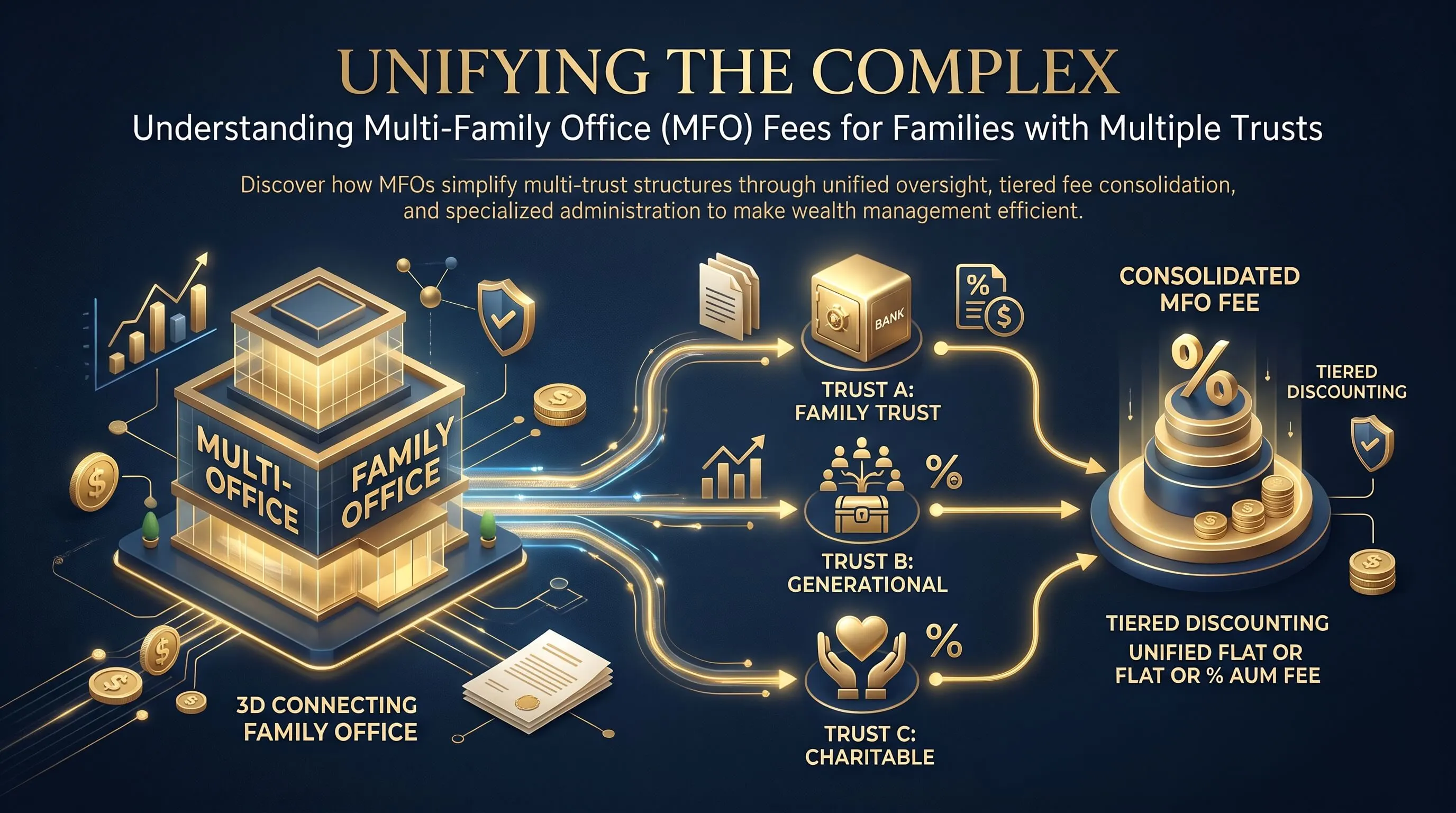
Here's the short version. Most multi-family offices bill the whole family relationship through an asset-based fee, a flat retainer, or a mix of the two. Trusts move that number in two places: how the firm groups their assets for fee tiers, and how much work and outside cost each trust brings with it.
If you're a grandparent paying private school tuition through a trust or a 529 plan, this matters sooner than you'd think. When a firm prices a small education trust on its own, it can become the most expensive money in the family plan.
TL;DR Quick Answers
Multi Family Office Services
Multi-family office services give a family one coordinated team for investments, tax, estate, and trust work, so every advisor works from the same full picture. For families with several trusts, most of the value comes from that coordination and follow-through, more than from any single service.
What they cover: investment oversight, consolidated reporting, trust and estate coordination, tax-time readiness, and family governance
Who they fit: families with complex wealth, often $25 million or more in investable assets, though some firms start at $10 million
How they're priced: an asset-based fee, a flat retainer, or a hybrid, usually across the whole family relationship
What they don't replace: your trustee, CPA, or estate attorney
What to ask first: which trusts count toward the fee, and which costs the fee leaves out
The better question is what the fee coordinates, not just what it costs.
Top Takeaways
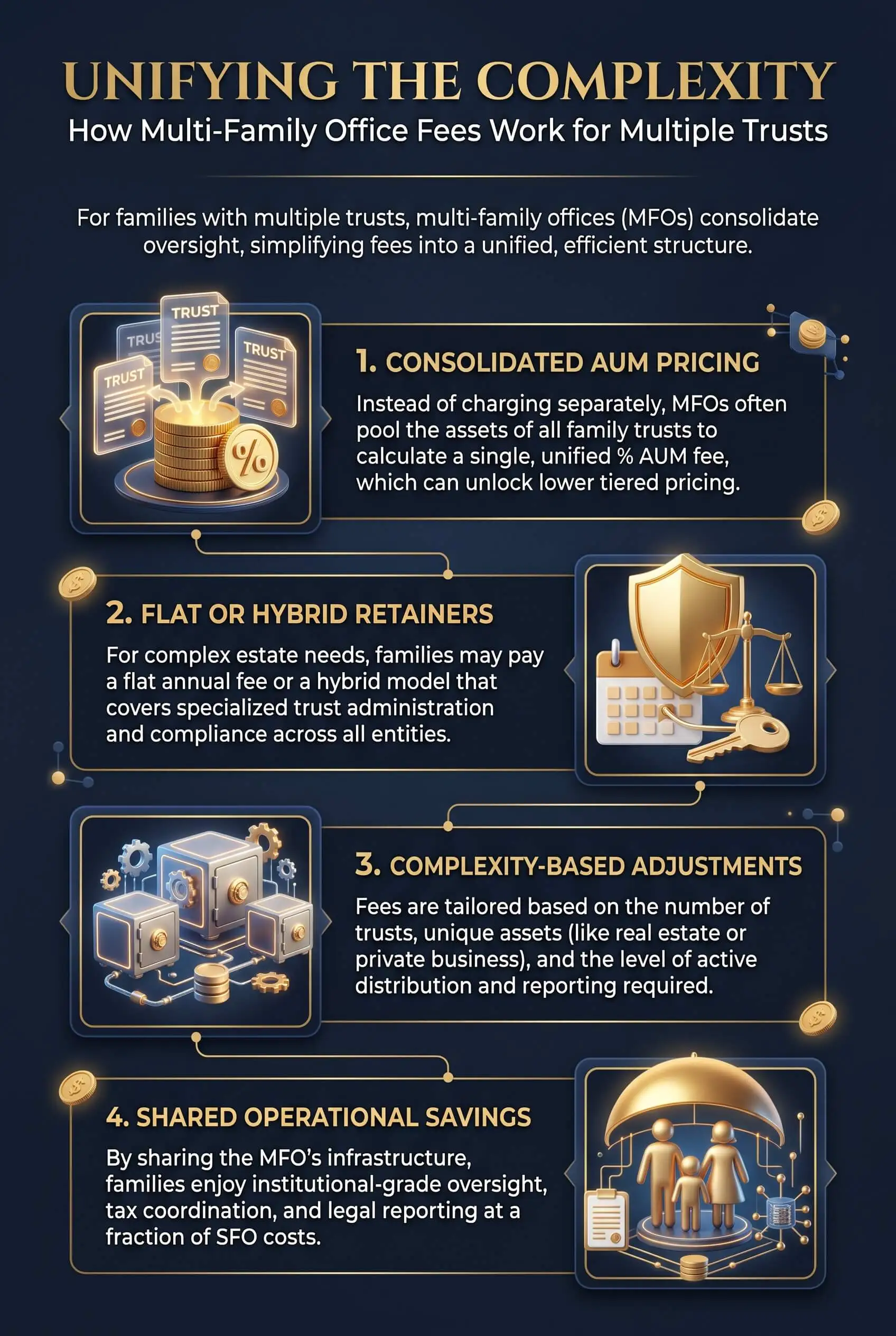
Most multi-family offices bill the whole family relationship through an asset-based fee, a flat retainer, a hybrid, or hourly work.
Trusts change the bill through how the firm groups their assets, how much coordination each one needs, and what it bills outside the fee.
Householding several trusts can cut the effective rate noticeably, so get in writing which trusts count.
Trustee fees, trust tax returns, legal work, and valuations are the costs most often missing from the quote.
Compare proposals on scope and accountability before you compare percentages.
What Multi-Family Office Services Usually Cover for Trusts
An MFO coordinates the people and paperwork around your trusts. It rarely replaces any of them.
On the trust side, the work usually looks like this:
Overseeing trust investments so each portfolio fits that trust's purpose and distribution rules
Building one consolidated report that shows every trust next to the family's other accounts and entities
Keeping trustees, beneficiaries, the CPA, and the estate attorney working from the same information
Tracking distributions, deadlines, and decisions that are still open
Gathering tax data early so the preparer can file every trust return on time
The MFO usually isn't the trustee unless it also runs a trust company, and it isn't the attorney who drafts or amends your documents. That gap is where many fee surprises start.
The Four Ways Multi-Family Offices Price Their Services
Every pricing model answers the same question a little differently. What is the family actually paying for?
Asset-based. You pay a percentage of assets under management, usually on a tiered schedule, and the firm may or may not add trust assets together for the lower tiers. This model suits families whose trusts hold mostly liquid investments. Watch for real estate, business interests, or life insurance inside trusts, which can sit outside the fee base while still creating work.
Flat retainer. One annual fee covers a defined scope, and the firm prices it on how many trusts, trustees, and entities it has to coordinate. It tends to fit families with many trusts or illiquid assets. The risk is a loose scope that slowly turns into add-on charges.
Hybrid. An asset-based fee covers the investments, and a separate planning fee covers the family office work, which is often where trust coordination lands. It works for a large portfolio paired with heavy coordination needs, as long as nobody bills the same work twice.
Hourly or project. The firm bills each trust review or restructuring on its own. That's fine for occasional needs and gets expensive once the work becomes routine.
Families with several trusts should take a hard look at the flat retainer. It prices coordination directly, and that matters when a trust holds farmland, a stake in a private company, or a life insurance policy an asset-based fee would barely notice. If you're still deciding whether outside coordination makes sense at all, our guide on when to outsource family office leadership walks through the signs.
Why Each Additional Trust Changes the Fee
Every trust is its own legal and tax entity, with its own trustee, beneficiaries, investment goals and, often, its own tax return. Add trust and you add work.
Revocable living trust. Firms usually count it with the grantor's household for fee tiers. While the grantor is alive, the IRS generally treats it as a grantor trust, so it doesn't file a separate return and the workload stays light.
Irrevocable non-grantor trust. Firms often count it toward breakpoints when a household member is the grantor or a beneficiary. It files its own Form 1041 and needs ongoing distribution decisions and trustee communication.
Dynasty or generation-skipping trust. Firms differ on whether it counts. It usually files Form 1041, runs for generations, and sometimes brings a corporate trustee into the picture.
Irrevocable life insurance trust. Some firms count it, though many leave out the policy's cash value. The work centers on premium funding, annual gift notices to beneficiaries, and policy reviews.
Charitable remainder trust. Counting varies by firm. It files Form 5227 every year and comes with required payouts, charitable reporting, and valuation work.
Education trust for grandchildren. Firms that aggregate often count it. The balances are small, but tuition distributions and 529 coordination still take time.
In our experience, separate filings and separate decision-makers drive most of the added cost. Each non-grantor trust usually files its own federal return, and some states want a fiduciary return as well. Different trustees mean more meetings and more chances for advice to conflict.
Then there's anything hard to value. Multi family office services help streamline the valuation of real estate and private company shares and partnership interests held in trust. These assets often need an appraiser for tax purposes and sometimes for billing.
How Householding Trust Assets Can Lower Your Rate
Householding means adding related accounts and trusts together so the family reaches lower fee tiers sooner. Plenty of advisers offer it. They don't all apply it the same way, and not every trust qualifies.
Here's a hypothetical using a sample schedule of 1.00% on the first $5 million, 0.75% on the next $5 million, 0.50% on the next $15 million, and 0.35% on anything above $25 million.
A revocable family trust with $30 million costs $180,000 a year if the firm bills it separately
A dynasty trust with $8 million costs $72,500
Three education trusts with $1 million each cost $30,000 combined
A charitable remainder trust with $2 million costs $20,000
Billed separately, the $43 million costs $302,500 a year, or about 0.70%
Householded, the same $43 million costs $225,500 a year, or about 0.52%
The only thing that changed is how the firm grouped the trusts for billing, and that choice is worth about $77,000 a year.
SEC examiners have flagged this exact problem. When they reviewed adviser billing practices, they found miscalculated breakpoints and family accounts that advisers never householded. Ask any firm you're considering to confirm in writing which of your trusts count toward the fee base.
Hidden Costs Families With Multiple Trusts Should Ask About
The quoted fee is rarely the whole cost. For families with several trusts, these items most often sit outside it.
Trustee fees. A corporate trustee or trust company usually charges on top of any advisory fee.
Trust tax returns. Preparers may bill per trust for each Form 1041 or Form 5227, plus any state fiduciary returns.
Outside legal work. Trust reviews, decanting, modifications, and new drafting typically show up on the attorney's invoice.
Valuations. Appraisers charge to value real estate, private company shares, or partnership interests held in trust.
Investment-level costs. Fund expense ratios, custody fees, and the separate fee layers inside private equity and other alternatives all sit beneath the advisory fee.
Minimums. Per-account, per-entity, or per-relationship minimums can make a small trust surprisingly costly.
Conflicts. Revenue sharing, proprietary products, or referral payments all belong in the firm's Form ADV.
Each of these is normal on its own, but a proposal that names none of them deserves a second look.
Where Education Trusts and Tuition Gifts Fit
Plenty of families in our community pay for private school with a mix of education trusts, 529 plans, and tuition that grandparents send straight to the school. Each gets different tax treatment and carries its own paperwork.
The fee lesson is simple. Bill a $1 million education trust on its own and it can cost far more per dollar than the same money counted inside the family's larger relationship. If you're mapping out how to pay for school, start with our guides on affording private school in California and the tax treatment of private school tuition, then ask your advisor how they price those education trusts.
How to Compare Multi-Family Office Fee Proposals
Two proposals can quote the same percentage and cover very different ground. These questions tend to expose the difference.
Which of our trusts and entities count toward the fee base, and which do you leave out?
Does the fee include trust coordination, or does that fall under a separate planning fee?
Who prepares each trust's tax return, and what will that cost?
Will you serve as trustee, or do we keep and pay a separate trustee?
How do you value illiquid trust assets for billing?
What happens to the fee when we add or fund a new trust?
Are you a fiduciary registered investment adviser, and what does your Form ADV say about householding and conflicts?
The better question goes past what multi-family office services cost to which costs the fee absorbs and which ones your family still carries.
"When a family brings us their trust agreements, the first thing we do is put every trust on one page. Who's the trustee, who are the beneficiaries, what does it hold, and who files its return? Most families have never seen that page, and filling it in usually takes a few rounds of calls. What we've found is that multiple trusts rarely get expensive on their own. The cost shows up in the handoffs between the trustee, the CPA, and the attorney, where nobody owns the follow-through, and that's also where fee surprises tend to hide. So before anyone signs anything, we ask them to get the scope in writing, trust by trust. You only know what a fee buys once you can see the list."
7 Essential Resources
We'd send a family to these first when they want to check a fact or vet a provider before signing a fee agreement.
IRS: About Form 1041, U.S. Income Tax Return for Estates and Trusts. Explains what a trust's fiduciary reports each year, which is why every non-grantor trust adds a return to the family's calendar.
IRS: About Form 5227, Split-Interest Trust Information Return. Covers the annual return of a charitable remainder trust file, worth a look if your family holds one.
SEC Investment Adviser Public Disclosure. Lets you pull any adviser's Form ADV and read its fee schedule, householding policy, and conflicts of interest.
Investor.gov: Form CRS Search. Finds a firm's plain-English relationship summary, including its suggested questions about fees.
Investor.gov: How Fees and Expenses Affect Your Investment Portfolio. Walks through how ongoing fees compound over the years, from the SEC itself.
Morgan Lewis: Control, Cost, and Complexity: Finding the Right Family Office Model. Compares single-family, multi-family, hybrid, and outsourced models, written in July 2026 by a law firm that advises family offices.
Asset Vantage: Family Office Fee Structure by Complexity, Not Just Net Worth. Argues that trusts, entities, and advisors should drive pricing, and lists the charges firms most often bill separately.
These resources explain trust tax filing requirements, investment adviser fees, and the costs of managing complex family wealth. They also offer guidance on evaluating family office services, selecting providers, and understanding how trusts, entities, and financial complexity influence overall fees.
3 Statistics
Roughly 130 SEC exams turned up fee problems at most firms. The SEC's Division of Examinations reviewed fee practices at about 130 registered investment advisers and found fee-related deficiencies at most of them, including miscalculated breakpoints and family accounts the advisers never householded. With several trusts in play, that's reason enough to check the math yourself. (SEC Risk Alert, November 2021)
Asset-based fees average around 0.50%, and flat fees can reach $1 million. A BDO Canada multi-family office director put the typical asset-based fee at about 50 basis points on investable assets, dropping as assets grow. Northwood Family Office's CEO said flat fees, which firms often use when much of a family's wealth sits outside investable assets, run from $100,000 to $1 million a year. (Canadian Family Offices)
A smaller single-family office costs about $0.9 million a year to run. J.P. Morgan surveyed 333 family offices and found that those with $250 million or less spend roughly $0.9 million a year to operate, with about 26% going to outside providers like legal, tax, and investment managers. Numbers like that explain why so many families with multiple trusts choose shared multi-family office services instead. (J.P. Morgan Private Bank, 2026 Global Family Office Report)
Final Thoughts and Opinion
In our view, the lowest headline fee is often the most expensive arrangement a family with several trusts can sign.
Trusts rarely lose money through the advisory fee itself. They lose it around the edges, through breakpoints nobody applied, a trust return no one owned until April, or a small education trust quietly paying the top rate. A trustee and an investment advisor working from different statements do the same kind of damage, just more slowly.
Coordination fixes that. A lower percentage on its own won't.
So when a proposal lands on your desk, read the scope before the price. Which trusts does it count, what work does it include, are philanthropic planning services covered, and what's left for you to discover later? A firm that answers clearly and in writing is usually the one worth paying, and a firm that can't is telling you something too.
Frequently Asked Questions
How do multi-family offices charge for multiple trusts?
Most charge one fee across the family relationship, using an asset-based schedule, a flat retainer, or a hybrid. Many firms add trust assets to the household total for fee tiers. A firm might build each trust's coordination into a retainer or bill it as a separate planning fee, so ask how it handles every trust.
Are trusts counted together for fee breakpoints?
Often, though not always. Many advisers aggregate a trust when a household member is its grantor or a beneficiary, while others exclude certain trusts or illiquid assets. The firm should spell out its rules in its Form ADV and your agreement. Ask for a written list of the trusts that count.
Does a multi-family office charge a separate fee for each trust?
Some do, through per-account or per-entity minimums or a planning fee that grows with the number of trusts. Others fold every trust into one retainer. Separate billing usually costs more, especially for small trusts that would otherwise sit inside a lower combined tier.
What hidden costs come with trusts?
The usual ones are corporate trustee fees, preparation of each trust's tax return, outside legal work, appraisals of illiquid trust assets, and fund or custody costs underneath the advisory fee. None of them is unusual. A good proposal names each one so you can compare providers on total cost.
Is trustee administration included in a multi-family office fee?
Usually not, unless the firm is also a trust company serving as trustee. Most multi-family offices work alongside the trustee instead of acting as one. If you have a separate trustee, expect a separate trustee fee, and ask how the two firms will split responsibilities.
Who pays the fee, the family or the trust?
That depends on the trust document, state law, and the trustee's decision. Trustees often pay fees tied to a trust's assets from that trust, while the family may pay for family-wide coordination personally or spread it across trusts. Your CPA and estate attorney can tell you how the split affects taxes and beneficiaries.
Ready to See What Your Trusts Really Cost?
Start with a single page. List every trust, who serves as its trustee, who the beneficiaries are, what each one holds, and who files its return. The gaps tend to show up fast. Multi-family office wealth management services can help identify and address those gaps.
When you'd like a second set of eyes, Legacy Bridge Private Family Offices offers a private consultation to map your trust structure, review how your current fees apply, and show how coordinated multi-family office services could work alongside the advisors you already trust.
One call. One team. One coordinated strategy.


