The beneficiary form on your 401(k) will outrank your trust, however carefully your attorney drafted it. So will the form on your life insurance policy and the transfer-on-death line on your brokerage account. Coordinating an estate plan with your financial accounts is practical work: you match every account title and beneficiary designation to your will or trust, correct the ones that disagree, and keep checking as life changes.
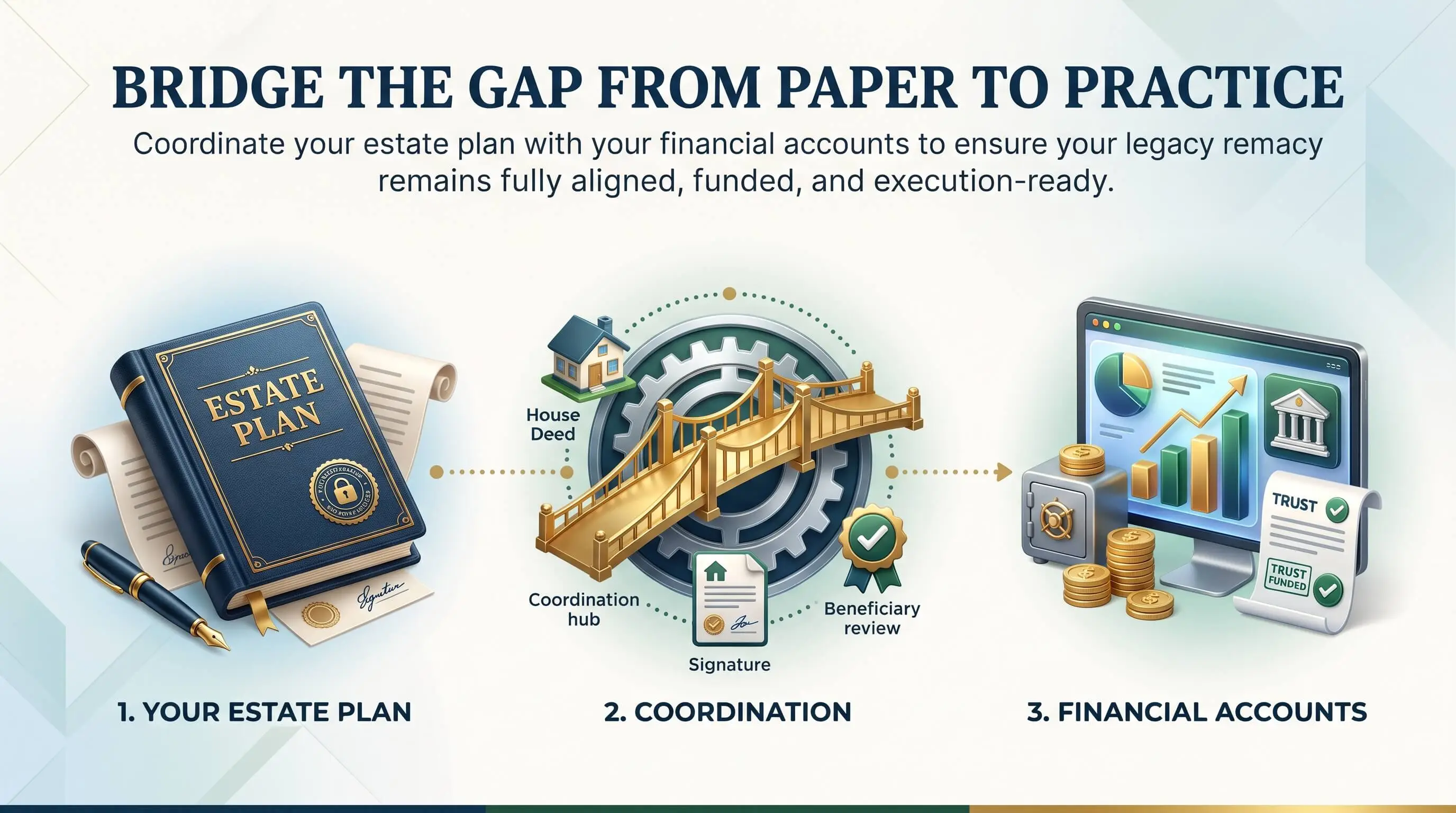
Families rarely get this wrong at the signing table. The plan drifts afterward, one account at a time, as the family opens new accounts on a bank's default settings and nobody revisits the old forms. Estate planning coordination closes that gap and carries the plan from paper into practice, keeping it execution-ready as assets and family circumstances change.
Parents and grandparents paying private school tuition usually feel the drift first. Between 529 plans, custodial accounts, and education trusts for several children, the account list grows every year, and every new account gives the plan one more place to slip.
TL;DR Quick Answers
Estate Planning Coordination
Estate planning coordination is the work of carrying your legal documents into every account, title, and beneficiary form, then keeping them aligned as life changes. It's how a plan moves from paper into practice.
What it is: matching accounts, titles, and beneficiary designations to your will and trust, then confirming each change.
What it covers: trust funding, account titling, beneficiary reviews, education accounts, and the records your executor will need.
What it is not: legal or tax advice. Your attorney and CPA keep those roles while coordination makes sure their recommendations get done.
Who needs it: families with trusts, a family business, property in more than one state, or education accounts for several children.
When to act: now, if you've never compared your accounts to your plan, and then every year after.
Top Takeaways
Beneficiary forms and account titles decide where most financial accounts go, and they override your will when the two disagree.
A revocable trust controls only the assets that have been retitled into it, so funding it is part of finishing the plan.
529 plans and custodial accounts need a named successor, or the plan's rules may send them through the estate.
Ask every institution to confirm changes in writing, since a form you mailed isn't always a form they processed.
Review the whole picture each year and after major life events, with one person responsible for the follow-through.
Why Your Will Doesn't Control Most of Your Accounts
Only assets left in your individual name, with no beneficiary attached, pass under your will through probate. Everything else follows a different set of instructions. IRAs, 401(k)s, life insurance, annuities, and accounts marked transfer on death (TOD) or payable on death (POD) go to whoever is named on the institution's form. Joint accounts pass to the surviving owner, and trust-owned accounts follow the trust.
Consider a composite we see often. A business owner's trust splits everything equally among three children, but his largest asset is a 401(k) opened two decades ago that still names his brother. The trust is well written. It just has no authority over that account, and nobody noticed because nobody went back to look. Family office services can help prevent these oversights by coordinating beneficiary reviews, asset records, and estate planning documents to ensure everything stays aligned with the family's intentions.
How Each Account Type Passes at Death
Use this as a map for conversations with your attorney, who decides how each account should be set up. Coordination makes sure it actually is.
Checking and savings: pass by title or a POD designation. Confirm whether each is individual, joint, or trust-owned, and whether a POD beneficiary is on file.
Brokerage accounts: pass by title or a TOD designation. Make sure the title matches the trust and a TOD form isn't quietly routing the account around it.
IRAs and 401(k)s: pass by the beneficiary form at the custodian. Name both primary and contingent beneficiaries, and ask your CPA how the choice affects taxes for heirs.
Life insurance and annuities: pass by the policy or contract beneficiary form. Check that names are current and that the trust is named where the plan calls for it.
529 plans: control passes to the successor owner named in the plan agreement. Name one, and confirm the student beneficiary is still right.
UTMA or UGMA accounts: a successor custodian takes over under state law. Name one, and know the age at which the child gains control.
Real estate: passes by recorded deed. If the plan says the trust should own the house, the deed has to say so too.
Business interests: pass by title and the operating or buy-sell agreement. Ownership should line up with both the trust and the succession plan.
Digital and online accounts: follow each platform's rules. Document logins and grant your executor clear authority.
Six Steps to Estate Planning Coordination
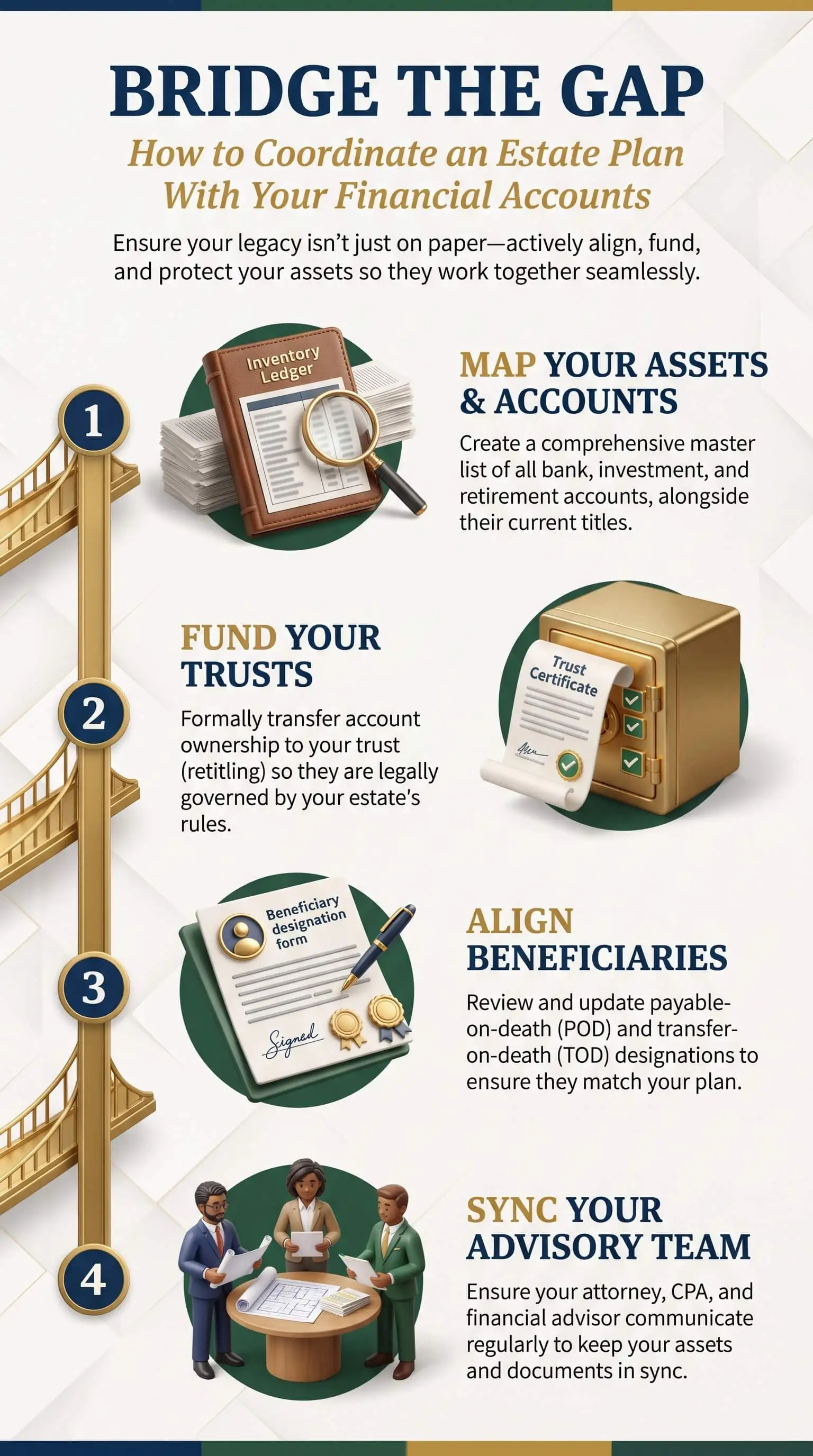
Estate planning coordination is detailed work, and plans fail in the details. We follow the same order with every family, moving from inventory and review through implementation and maintenance.
Inventory everything. Write down every account, policy, property, and entity in five columns: asset, current title, how it transfers, named beneficiary or co-owner, and rough value. Very few families finish this from memory.
Get the forms in writing. Request current beneficiary designations and account agreements from each institution. What's on file today may not be what you remember signing.
Compare against the plan. Set the inventory beside your will and trust and mark every mismatch, including missing contingent beneficiaries.
Fund the trust. Retitle the accounts and deeds the plan says the trust should own. A revocable trust controls only what has been placed in it.
Update and verify. Submit new designations, then ask each institution to confirm in writing that the change took effect. Mailed forms do go missing.
Maintain the plan. Review once a year, and again after a marriage, divorce, birth, death, move, business sale, or change in tax law.
Where Good Plans Quietly Come Apart
In our experience, mismatches rarely come from bad legal work. They build up slowly, one ordinary financial decision at a time.
Old names on old forms. A former spouse, a parent who has passed, or no mention of a child born after the form was signed.
No contingent beneficiary. If the primary has died, the account can fall back into probate.
TOD and POD forms that bypass the trust. When liquid accounts pass outside the estate, the estate may be left with real estate or business interests and no cash to cover taxes and expenses.
A trust that was signed but never funded. It's one of the most common gaps we see.
Accounts opened after the plan. Rollover IRAs and new brokerage accounts often carry a blank beneficiary line.
Accounts nobody remembers. An old 401(k) or a small savings account can end up as unclaimed property held by the state.
Coordinating Education Accounts With Your Estate Plan
Education money deserves its own review because it almost never follows the will. A 529 plan belongs to its account owner, and the plan's paperwork decides who steps into that role. If the owner never names a successor, the plan's rules may send the account through the owner's estate. Grandparent-owned 529s and custodial UTMA accounts need the same check, especially when several grandchildren are involved.
If your family is still working out how to fund tuition, our guides on paying for private school and the tax treatment of tuition in California pair well with this checklist.
Who Should Coordinate the Plan?
Someone has to own the follow-through. Your estate planning attorney drafts the documents and gives legal advice, and your CPA handles the tax side. Your financial advisor manages the investments. When no one tracks what happens between those meetings, an attorney's recommendation can sit unexecuted at the brokerage for a year.
Families with several trusts, entities, or properties, or with holdings in more than one state, often bring in a Personal CFO or family office team as the coordinating partner who leads that work. Legacy Bridge Private Family Offices fills this role alongside a family's existing attorney and CPA, verifying trust funding, titling, and beneficiary alignment, and keeping records execution-ready as assets and family circumstances change.
"The first meeting with a new family usually starts the same way. We put the trust documents on one side of the table and the account statements on the other, and we read them against each other line by line. They almost never match completely. We've opened trusts that were signed years earlier and still held nothing, and life insurance policies naming a parent who had died long before. The attorneys did their part well, and their documents did exactly what documents can do. What was missing was someone to take the plan off the page, carry it into every account, and come back to check on it each year. The work is unglamorous, and it decides whether a family's intentions actually hold. We want the next generation to inherit a plan they can follow without guesswork, even in the hardest week of their lives."
7 Essential Resources
These are worth bookmarking before your next meeting with your attorney or CPA.
IRS Retirement Topics: Beneficiary: the IRS rules for how inherited IRAs and retirement plans are distributed and taxed, which differ by who the beneficiary is.
IRS 529 Plans: Questions and Answers: education savings basics, including the gift tax points grandparents ask about most.
IRS Frequently Asked Questions on Estate Taxes: current filing thresholds and who handles what when an estate is settled.
Goodwin: Transfer-on-Death Designations, Potential Pitfalls: a law firm's look at how TOD and POD forms can pull money away from a trust and leave an estate short of cash.
SmartAsset: Beneficiary vs. Will: a short, plain-English explanation of why beneficiary forms outrank a will.
Wiss: The Quarterback Approach to Estate and Wealth Planning: makes the case that advisors need to be aligned, not merely aware of each other.
Advisor Perspectives: Coordinating Your Estate Plan and Financial Plan: a September 2026 piece on keeping investments, retirement accounts, taxes, and estate documents pointed in the same direction.
3 Statistics
In Caring.com's 2025 survey, 24% of U.S. adults said they have a will, down from 33% in 2022. Nearly one in four people who do have one haven't updated it since the day they wrote it. (Caring.com 2025 Wills Study)
State unclaimed property offices returned about $4.25 billion to owners in fiscal 2025, which ran from July 2024 through June 2025. That money began as dormant accounts, uncashed checks, and unpaid policy proceeds that owners and heirs lost track of. (NAUPA FY25 Report)
Cerulli Associates projects $124 trillion will change hands through 2048, with $105 trillion going to heirs and $54 trillion passing first between spouses. For married couples, that means beneficiary forms get tested at two different deaths. (Cerulli Associates, December 2024)
Recent studies highlight the importance of keeping estate plans updated, tracking financial assets, and preparing for generational wealth transfers. With only 24% of U.S. adults having a will in 2025, billions in unclaimed property, and $124 trillion expected to change hands through 2048, families need better coordination of their financial and inheritance plans. Philanthropic planning services can complement this process by helping families align charitable giving goals with estate planning strategies, supporting organised wealth transfers and a lasting family legacy.
Final Thoughts and Opinion
We think families should treat an estate plan like a tuition budget, checking it against reality every year instead of filing it away once everyone signs.
The drafting is rarely the weak point. Families hire capable attorneys, and the documents reflect careful thought about who should receive what. The trouble starts later, with the brokerage account opened on a busy afternoon, the refinance that changes how the house is titled, or the 401(k) rolled into an IRA with a blank beneficiary line. None of those moments feels like an estate planning decision, yet each one changes the plan.
That's why we treat estate planning coordination as proactive maintenance instead of a scramble at each life event. An annual review takes a few hours. Untangling a mismatched account after a death can take months and strain relationships that matter far more than the money. If you do one thing this year, build the inventory. With every account and its beneficiary on a single page, the gaps tend to show themselves.
Frequently Asked Questions
Do beneficiary designations override a will?
In most cases, yes. Retirement accounts, life insurance, annuities, and TOD or POD accounts go to the people named on the institution's form, whatever the will says. Review those forms alongside your will and trust so all three point the same way.
What does it mean to fund a trust?
Funding a trust means retitling assets so the trust owns them, or naming the trust as beneficiary where the plan calls for it. A trust with nothing in it controls nothing. Funding is the step families most often leave unfinished after signing.
What is estate planning coordination?
Estate planning coordination is the work of carrying your legal documents into every account, title, and beneficiary form, then keeping them aligned as life changes. It connects your attorney's plan with what is actually on file at each bank, brokerage, and insurer.
How often should you review beneficiary designations?
Once a year works well for most families. Review again after a marriage, divorce, birth, death, move, business sale, or new account. Ask each institution for written confirmation after any change so you know it was processed.
What happens to a 529 plan when the account owner dies?
Control passes under the plan's account agreement, usually to a named successor owner. If the owner never named a successor, the plan's rules may send the account through the owner's estate. Check every 529 and confirm the successor fits your wider plan.
Who coordinates an estate plan across the attorney, CPA, and financial advisor?
Often nobody, and that's where most gaps start. Some families ask one advisor to lead. Others bring in a Personal CFO or family office team to track implementation, keep records current, and make sure each professional's recommendations get carried out.
Ready to Make Your Estate Plan Work in Practice?
Start with a single page listing every account, policy, and property you own, how each is titled, and who is named as beneficiary. Lay it beside your will and trust. The first mismatch often shows up quickly. Family office concierge services can help identify these gaps and coordinate with your advisors to keep your estate plan aligned.
When you'd like help closing those gaps, Legacy Bridge Private Family Offices offers a private consultation. We'll review your accounts against your plan and coordinate trust funding, titling, and beneficiary updates alongside the attorney and CPA you already trust.


