Picture 9 p.m. the night before a trust signing. Someone in the family is searching three inboxes for the latest amendment. The assistant knows exactly where it is, and the assistant is on a flight.
That scene shows what a family office administrative assistant does and where the role runs out of room. Day to day, this person keeps a wealthy family's calendars, records, payments, and advisor follow-ups in order. The job combines a secretary's core duties with the discretion of private household work, usually across several family members, entities, and properties at once.
In our experience, good assistants finish their tasks. The handoffs are what slip: the CPA waiting on a document the estate attorney already sent, or an action item from last month's meeting that nobody owns. That gap is why many families pair a capable assistant with family office administrative support, a structured system that keeps documents, providers, and deadlines moving in one direction.
Families paying private school tuition feel the load early. Enrollment contracts, tuition schedules, financial aid forms, 529 statements, and education trust paperwork land on the same desk as tax documents and insurance renewals. Below, we walk through the assistant's day, the point where one person reaches the limit, and what structure adds.
TL;DR Quick Answers
Family Office Administrative Support
Family Office Administrative Support is a structured system that keeps a family's documents organized, advisors aligned, and deadlines met, with one accountable team owning follow-through. It works alongside your CPA, attorney, and insurance advisor and never replaces them.
Core services: document management, an encrypted electronic vault with defined permissions, and provider coordination.
Key workflows: advisor action-item tracking, entity record continuity for LLCs and trusts, signature and notary coordination, and insurance renewal oversight.
Why it matters: records and deadlines stay visible to more than one person, so a vacation or staff departure never stalls the family's financial life.
Who it fits: families with multiple entities, trusts, properties, or advisors.
When to start: before a business sale, relocation, estate update, or key staff change.
Top Takeaways
A family office administrative assistant manages calendars, correspondence, records, bill pay, advisor follow-ups, and family logistics across personal and business life.
The role pairs a secretary's core duties with the discretion of private household work, often for several family members and entities at once.
Even a capable assistant creates key-person risk when records and advisor relationships live in one inbox or one memory.
Family Office Administrative Support adds centralized document management, secure vaulting, provider coordination, and tracked follow-through.
Families get the best results by pairing a strong assistant with a system that works alongside their CPA, attorney, and insurance advisors.
A Day in the Life of a Family Office Administrative Assistant
The details change daily. The rhythm holds steady, moving between the family's personal life, its businesses, and the advisors who serve both.
Morning
Triage email and voicemail, flagging anything time-sensitive for the principal.
Reconcile calendars across family members, board seats, school events, and travel.
Review the bills and invoices waiting for approval, then send wire requests through the family's sign-off process.
Midday
Chase the CPA for missing tax documents, or nudge the estate attorney on a draft that needs review.
Confirm next week's travel, aviation, or residence logistics.
Work with household staff and property vendors on repairs, deliveries, and access.
Afternoon
File new statements, policies, and signed agreements in the right folders.
Build an agenda and document packet for the next advisor meeting.
Log renewal dates for insurance, vehicle registrations, and entity filings.
End of day
Update the open-items list so nothing depends on memory.
Send the principal a short recap: what moved, what's pending, and what needs a decision.
Core Family Office Assistant Duties Beyond the Daily List
Seven ongoing responsibilities sit underneath that routine. Most job descriptions for the role include some version of each.
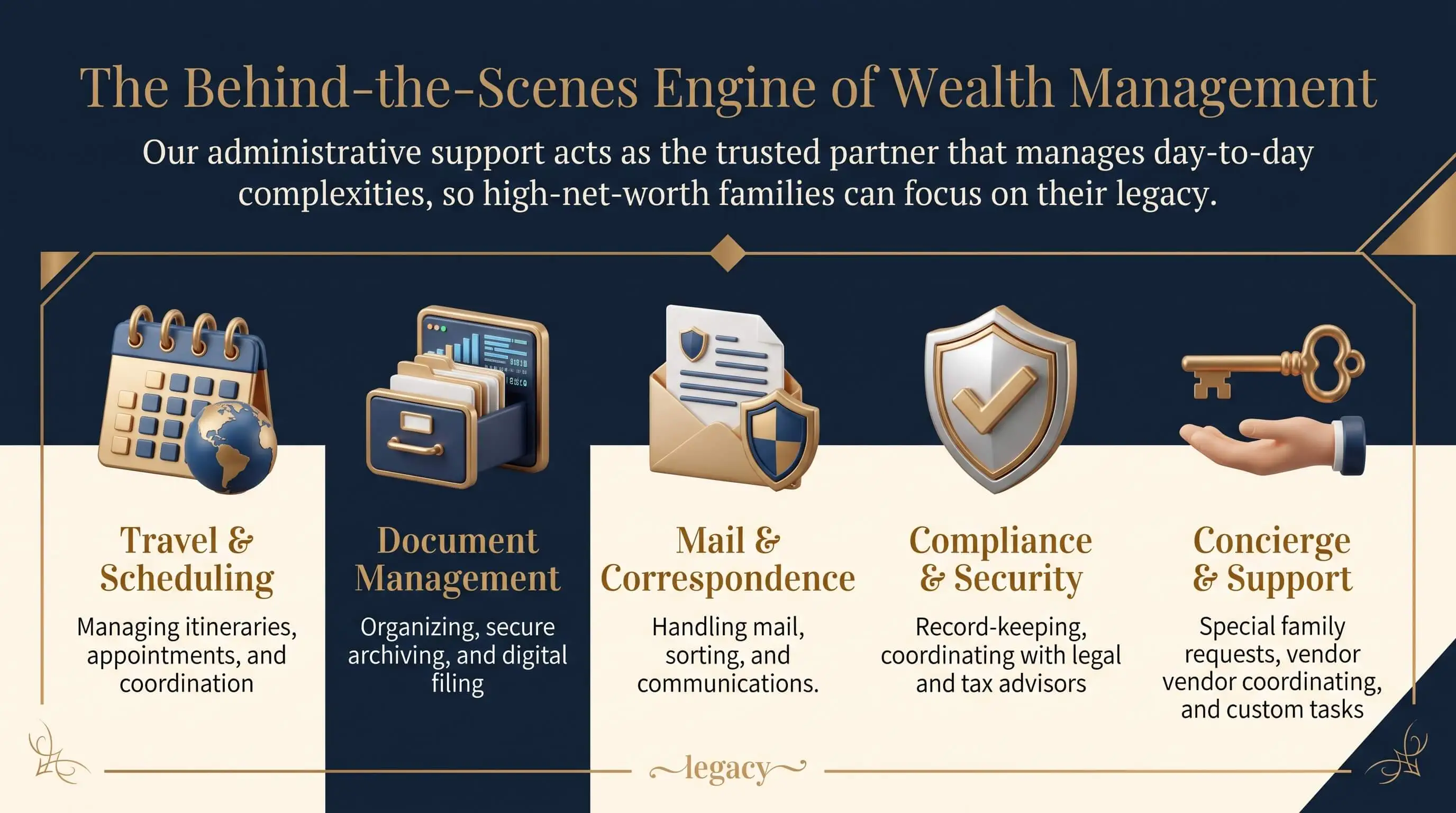
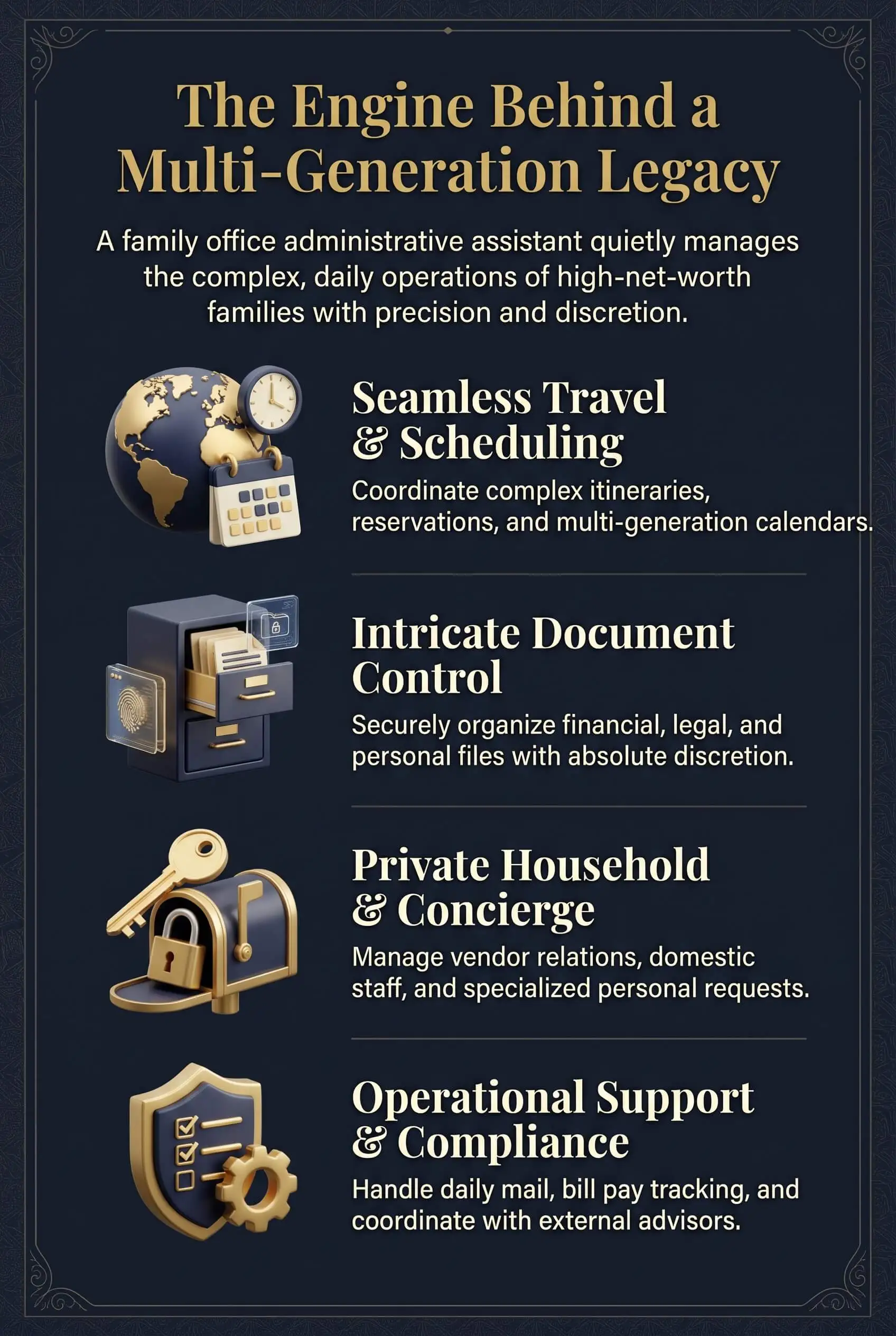
Calendar and travel management. The assistant keeps personal, family, and business schedules in one coordinated view.
Correspondence and gatekeeping. The assistant decides what reaches the principal, what gets a reply, and what goes elsewhere.
Records and document management. The assistant keeps trusts, wills, deeds, titles, tax returns, and policies organized and current.
Bill pay and expense tracking. The assistant routes payments for approval, records them, and reconciles them against statements.
Advisor and vendor liaison. Attorneys, CPAs, insurers, and service providers call the assistant first.
Deadline tracking. Entity filings, insurance renewals, signature dates, and school deadlines all live on one calendar the assistant owns.
Family logistics and events. The assistant plans gatherings, celebrations, and multi-generational trips, then makes them happen.
Administrative Assistant vs. Executive Assistant vs. Family Office Administrative Support
People use these terms interchangeably. Each one describes a different level of responsibility.
Family office administrative assistant
Scope: day-to-day clerical, scheduling, filing, and payment tasks.
Follow-through: completes assigned work and relies on the principal to escalate.
Continuity: one person holds the knowledge.
Best fit: families with moderate complexity and a clear decision-maker.
Family office executive assistant
Scope: senior support for the principal, including research, gatekeeping, and travel.
Follow-through: manages the principal's priorities, often across business and personal life.
Continuity: still tied to one relationship.
Best fit: a principal with a demanding schedule and many outside commitments.
Family Office Administrative Support
Scope: a structured system for document management, secure vaulting, provider coordination, and repeatable workflows.
Follow-through: one team owns every advisor action item until it closes.
Continuity: records, permissions, and processes stay put when people change.
Best fit: families with multiple entities, trusts, properties, or advisors who need everyone aligned.
Where a Single Assistant Reaches the Limit
We value strong assistants. The structure around them decides whether the family stays organized when life gets complicated.
Key-person risk. A longtime assistant who leaves often takes passwords, vendor relationships, and the reasoning behind past decisions along too.
Records in too many places. Documents scatter across an inbox, a desk drawer, and four separate advisor portals.
The family becomes the messenger. With no one coordinating providers, family members end up relaying information between the CPA and the attorney themselves.
Inconsistent access. Without defined permissions, people send sensitive files by email.
We see this pattern often. Administration stays reactive and time-consuming until someone designs it to be proactive and reliable.
What Structured Family Office Administrative Support Adds
Administrative support is not logistics. It is a structured system that keeps the family's financial life organized and executed, with one team and one point of coordination behind the assistant's task list.
Document management. We centralize personal and financial records with version control, so everyone works from the current copy.
Electronic vault services. We store wills, trusts, tax returns, and titles with encryption, multi-factor access, and defined permissions.
Provider coordination. We give attorneys, CPAs, insurance advisors, and specialists shared context, then track their action items to completion.
Signature and notary coordination. We schedule execution well ahead of filing deadlines, not the day before.
Insurance schedule oversight. We track renewals and coverage across every provider.
Entity record continuity. We keep records for LLCs and trusts currently through business sales, relocations, and generational transitions.
All of this happens alongside the family's professionals. Your CPA, attorney, and insurance advisor stay in their lanes. Administrative support keeps those lanes connected and moving. It forms the operational layer beneath the leadership roles covered in our look at when a family should consider outsourcing family office leadership.
Education Paperwork Belongs in the System Too
Private school tuition brings its own steady paperwork. Enrollment contracts, tuition schedules, financial aid forms, 529 distributions, and education trust records all need a home, and the CPA needs them at tax time. If you're weighing the cost side, start with our guides on affording private school in California and the tax treatment of private school tuition.
Skills and Safeguards to Look For
Look for these qualities whether you hire an assistant, engage a support team, or do both.
Discretion. A signed confidentiality agreement and a track record with private clients.
Defined permissions. Clear rules on who can view, share, or approve each type of document and payment.
Organized recordkeeping. One folder structure and naming system that anyone on the team can follow.
Backup coverage. A named person who steps in during vacations, illness, or turnover.
Advisor fluency. Comfort working with attorneys and CPAs without drifting into legal or tax advice.
"We ask every family one question early on: if your assistant were unreachable for two weeks, who would know which wire is pending, where the current trust amendment lives, and what the CPA still needs? Most families pause before they answer. That pause says nothing bad about the assistant, who is usually excellent and carrying far too much in their head. We build the structure around that person. Documents live in one secure place with clear permissions. We track advisor action items until they close, and more than one person can see every recurring deadline. Once that's in place, a great assistant gets even better, because the work no longer runs on memory."
7 Essential Resources
Use these to define the role, compare support models, and set your family's recordkeeping rules.
BLS Occupational Outlook Handbook: Secretaries and Administrative Assistants: the federal baseline for duties, training, pay, and outlook, with a separate breakout for executive assistants.
IRS Topic No. 305, Recordkeeping: the IRS explains how long to keep tax and property records, a practical starting point for any retention policy.
Praxis: Family Office Support and Governance: Praxis lists the administrative functions it manages for families, from document control and bill payment to household payroll and advisor coordination.
AlTi Global: Family Office Administration Services: AlTi describes a single-point-of-contact role alongside secure document storage, bill pay, and tax document coordination.
Bessemer Trust: Family Office Services: Bessemer shows where bill payment, accounting, and household HR fit inside ongoing support.
C-Suite Assistants: Executive Assistants for Family Offices: a recruiter's take on the tasks and traits families want, from running residences to working with advisors.
CNBC via NBC Los Angeles: Family Offices Are Paying Executive Assistants Up to $190,000 a Year: recruiters describe the role's scope, its travel demands, and the experience families expect.
3 Statistics
Family offices pay executive assistants a median base salary of $100,048, according to a Botoff Consulting survey of 436 family offices and family investment firms. Bonuses typically add another 10% to 20%. Families pay that premium because so much responsibility now sits with one role. (CNBC via NBC Los Angeles, January 2025)
Secretaries and administrative assistants earned a median annual wage of $48,310 in May 2025. Executive secretaries and executive administrative assistants earned a median of $76,590. Family office roles pay well above both. (U.S. Bureau of Labor Statistics, Occupational Outlook Handbook)
More than half of estate and household staff received raises in the first quarter of 2026, according to Botoff Consulting's 2026 Estate and Household Staff Compensation Report, which drew on 417 UHNW families and family offices. As keeping good people gets more expensive, continuity planning matters more. (Family Wealth Report, September 2026)
These statistics highlight the rising cost of hiring and retaining skilled family office administrative staff, with executive assistants earning significantly more than traditional administrative professionals. As compensation increases, family offices must prioritise efficient staffing, continuity planning, and specialised support to manage daily operations, coordinate advisors, and oversee responsibilities such as philanthropic planning services.
Final Thoughts and Opinion
We respect the people who do this work. A skilled family office administrative assistant keeps a complicated life moving, usually without much credit, and any family lucky enough to have one should hold on to them.
Here is where we land. A family's records, permissions, and advisor follow-through should never depend on one person's memory. When they do, a vacation or a resignation turns into a risk to the family's financial life. We've watched families spend weeks rebuilding what a departing assistant knew. We've also watched families with a system already in place get through the same change calmly.
The best setups we see use both. A capable assistant runs the day, while structured Family Office Administrative Support keeps documents centralized, advisors aligned, and deadlines visible to more than one person. That structure makes the assistant's work more valuable.
If you're choosing between hiring and building structure, we usually recommend starting with the structure. It gives every assistant, current or future, solid ground to work from.
Frequently Asked Questions
What does a family office administrative assistant do day to day?
They manage calendars across family and business life, triage correspondence, and route bills and wire requests for approval. They also chase advisors for follow-ups, coordinate travel and household vendors through family office concierge services, and file statements and signed documents. Renewal and filing deadlines go on their calendar too. Most send the principal a short end-of-day recap of what moved and what needs a decision.
What is Family Office Administrative Support?
Family Office Administrative Support is a structured system that keeps a family's financial life organized and executed. It typically covers document management, a secure electronic vault with defined permissions, and coordination of attorneys, CPAs, and insurance advisors. It also adds repeatable workflows for signatures, renewals, and entity records. One team owns the follow-through.
How is a family office assistant different from an executive assistant?
An administrative assistant handles day-to-day clerical, scheduling, filing, and payment tasks. An executive assistant gives the principal senior support, including research, gatekeeping, and complex travel. The titles overlap in practice. What matters more is whether either role works inside a structured system or carries the family's administration alone.
Does administrative support replace my CPA or attorney?
No. Administrative support works alongside your professionals. Your CPA still gives tax advice, and your attorney still gives legal advice. The support team keeps both working from the same information, gathers documents before deadlines, and tracks every meeting's action items until they close.
How are family documents kept secure?
Security starts with one central home for critical records, such as an encrypted electronic vault with multi-factor access. Each family member, assistant, and advisor gets permissions matched to what they actually need. Consistent rules for sharing and naming files keep sensitive documents out of email.
When should a family move from one assistant to a structured support system?
Consider it once your family holds multiple entities, trusts, or properties, or when documents sit scattered across advisors and inboxes. A coming transition is another strong signal, whether that's a business sale, a move, an estate update, or a longtime assistant's departure. Building structure before the change is far easier than building it during.
Ready for Less Admin, More Life?
Try one exercise this week. Write down every important document, every advisor, and every recurring deadline your family has, all in one place. The gaps usually show up fast.
When you're ready to close them, schedule a private consultation with Legacy Bridge Private Family Offices. Guided by Midwestern values and a commitment to discretion, we'll map your documents, providers, and obligations. Then we'll show you how Family Office Administrative Support, as part of our comprehensive family office services, can bring structure and follow-through to your family's financial life, working alongside the advisors you already trust. You end up with a secure source of truth for your family's most important records.